
How to Measure Curtains: A Complete Step-by-Step Guide
Choosing beautiful curtains is only half the job. Getting the right measurements is just as important if you want your curtains to look full, balanced, and professionally fitted.
Curtains that are too narrow may look flat, while panels that are too short can make a window appear smaller. Fortunately, measuring curtains is simple when you know what to measure.
This guide explains how to measure curtains for width, length, curtain rods, and different types of windows.
1. Measure the Window Width


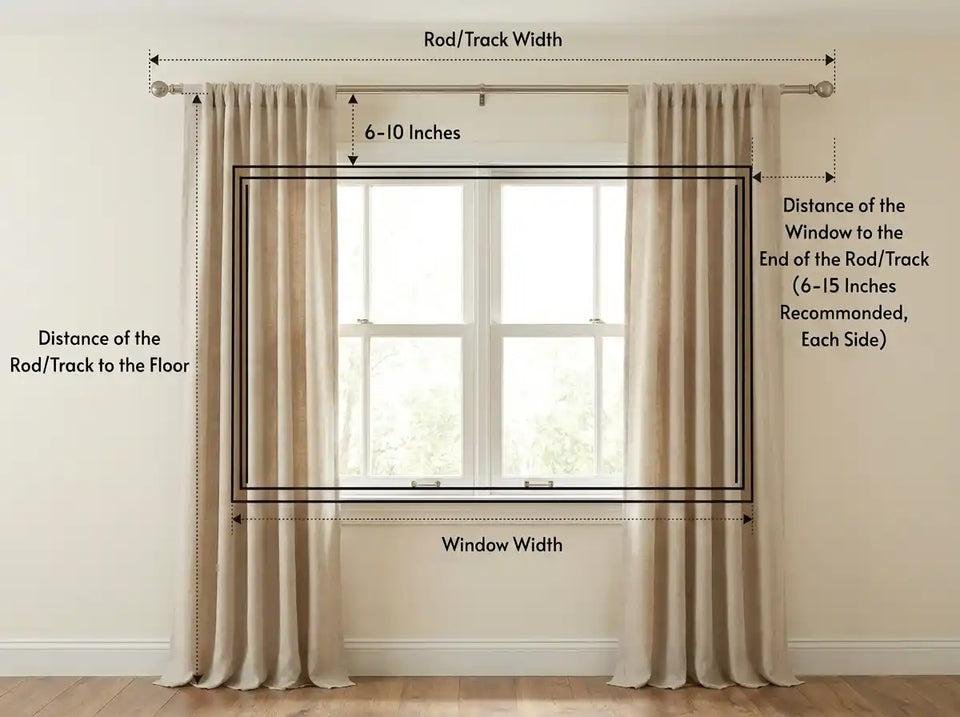
Start by measuring the width of your window from one outside edge to the other.
Use a metal tape measure and record the measurement in inches or centimeters. Measure across the window frame rather than measuring only the glass.
For a more accurate result, measure the width at the top, middle, and bottom of the window. If the measurements are slightly different, use the largest measurement.
2. Measure the Curtain Rod Width


Your curtain rod is usually wider than the actual window. Extending the rod beyond both sides allows the curtains to sit beside the window when they are open.
A common approach is to extend the rod about 6 to 12 inches beyond each side of the window, depending on the available wall space.
This can also make the window look wider.
3. Measure for Curtain Fullness


Curtains need extra fabric to create natural folds. The curtain width should therefore be greater than the width of the rod.
For a fuller appearance, you can use around 1.5 to 2.5 times the rod width, depending on the fabric and desired look.
Lightweight fabrics often benefit from more fullness, while heavier fabrics may require less.
4. Measure From the Curtain Rod to the Floor


For floor-length curtains, measure from the point where the curtain will hang to the floor.
Do not automatically measure from the top of the window. Your curtain rod may be several inches above the window frame.
Take the measurement from the actual hanging point to the floor for the most accurate result.
5. Decide Where to Mount the Curtain Rod


The position of the curtain rod affects the final curtain length.
Mounting the rod several inches above the window can make the room feel taller. In many homes, placing the rod closer to the ceiling creates an especially elegant appearance.
However, always consider the available wall space and the height of the window.
6. Measure for Curtains That Touch the Floor


If you want curtains that just touch the floor, measure from the curtain hanging point to the floor.
Then consider the curtain heading and hardware. Depending on whether you use rings, hooks, tabs, or a rod pocket, the actual finished length may vary.
Always check the manufacturer’s measurement method before ordering ready-made curtains.
7. Measure for Puddle-Length Curtains


Puddle-length curtains extend beyond the floor and create extra fabric at the bottom.
This style can create a romantic or luxurious appearance, but it is usually better suited to decorative spaces where the fabric will not interfere with everyday movement.
Add extra length according to the amount of pooling you want.
8. Measure Curtains for Small Windows


Small windows can still look elegant with properly measured curtains.
Consider extending the rod beyond the window and mounting it higher than the frame. Floor-length curtains can make a small window appear taller and more substantial.
Avoid choosing panels that are too narrow for the rod.
9. Measure Curtains for Large Windows


Large windows require careful width measurements. Measure the entire area that you want the curtains to cover.
For very wide windows, you may need multiple curtain panels. Divide the total required fabric width between the number of panels you plan to use.
This creates better coverage and more balanced folds.
10. Measure Curtains for Sliding Glass Doors


Sliding glass doors usually need wider curtains than standard windows.
Measure the entire width of the door area, including the space where the curtains will stack when opened.
Make sure the curtain rod or track is strong enough to support the larger panels.
11. Measure Curtains for Bay Windows


Bay windows can be more challenging because they contain multiple sections.
Measure each window section separately if you plan to use individual curtain panels. If you are installing one continuous treatment, measure the complete track or rod instead.
Consider the shape of the bay window before choosing your curtain hardware.
12. Measure Curtains for French Doors


French doors often require curtains that cover a larger vertical area.
Measure the width of the complete door section and the height from the curtain hanging point to the desired bottom position.
Make sure there is enough space for the curtains to open without blocking the doors.
13. Measure Curtains for Inside-Mount Installation


Some window treatments are installed inside the window frame rather than outside it.
For an inside mount, carefully measure the exact inside width and height of the frame. Measure in multiple places because window frames are not always perfectly square.
Use the smallest measurement when the product instructions require a precise fit.
14. Measure Curtains for Outside-Mount Installation


Outside-mounted curtains sit beyond the window frame. This style gives you more flexibility with both width and height.
Measure the area you want the curtains to cover, including the extra space around the window.
Outside mounting can also help make windows appear larger.
15. Check Your Measurements Before Buying


Before ordering curtains, check every measurement one more time.
Write down the:
- Window width
- Curtain rod width
- Desired curtain length
- Number of panels
- Curtain fullness
- Hanging method
Also check the manufacturer’s sizing information. Different curtain styles can use different measurement methods.
How Much Curtain Width Do You Need?
The amount of fabric you need depends on the fullness you want.
A simple guideline is:
Rod width × fullness = total curtain fabric width
For example, if your curtain rod is 60 inches wide and you want 2 times fullness:
60 × 2 = 120 inches of total fabric
You can then divide that width between two curtain panels if you want one panel on each side.
Always check the manufacturer’s recommendations because fabric width and finished panel sizes can vary.
How to Measure Curtain Length Correctly
The most important thing is to measure from the actual hanging point rather than automatically starting at the window frame.
Decide first whether you want:
- Curtains that touch the floor
- Curtains slightly above the floor
- Puddle-length curtains
- Curtains that stop below the window
Once you decide on the style, measure carefully and account for the curtain heading or hardware.
Common Curtain Measuring Mistakes
Avoid these common mistakes when measuring your curtains:
Measuring Only the Glass
The glass area does not always represent the full curtain coverage you need.
Forgetting Curtain Fullness
Using the exact window width can result in flat-looking curtains.
Measuring From the Window Instead of the Rod
If your rod sits higher than the window, your curtain length measurement will be incorrect.
Ignoring the Curtain Heading
Different hanging methods can change the finished curtain length.
Not Checking the Product Size
Ready-made curtains often list panel width and length differently. Read the product measurements carefully before ordering.
Final Thoughts
Measuring curtains does not have to be complicated. Start with the window width, decide where you want the curtain rod, calculate the required fullness, and then measure the desired curtain length.
Take your measurements carefully and check them twice before buying.
With accurate measurements, you can choose curtains that fit beautifully, create natural folds, and give your windows a polished finished look.